

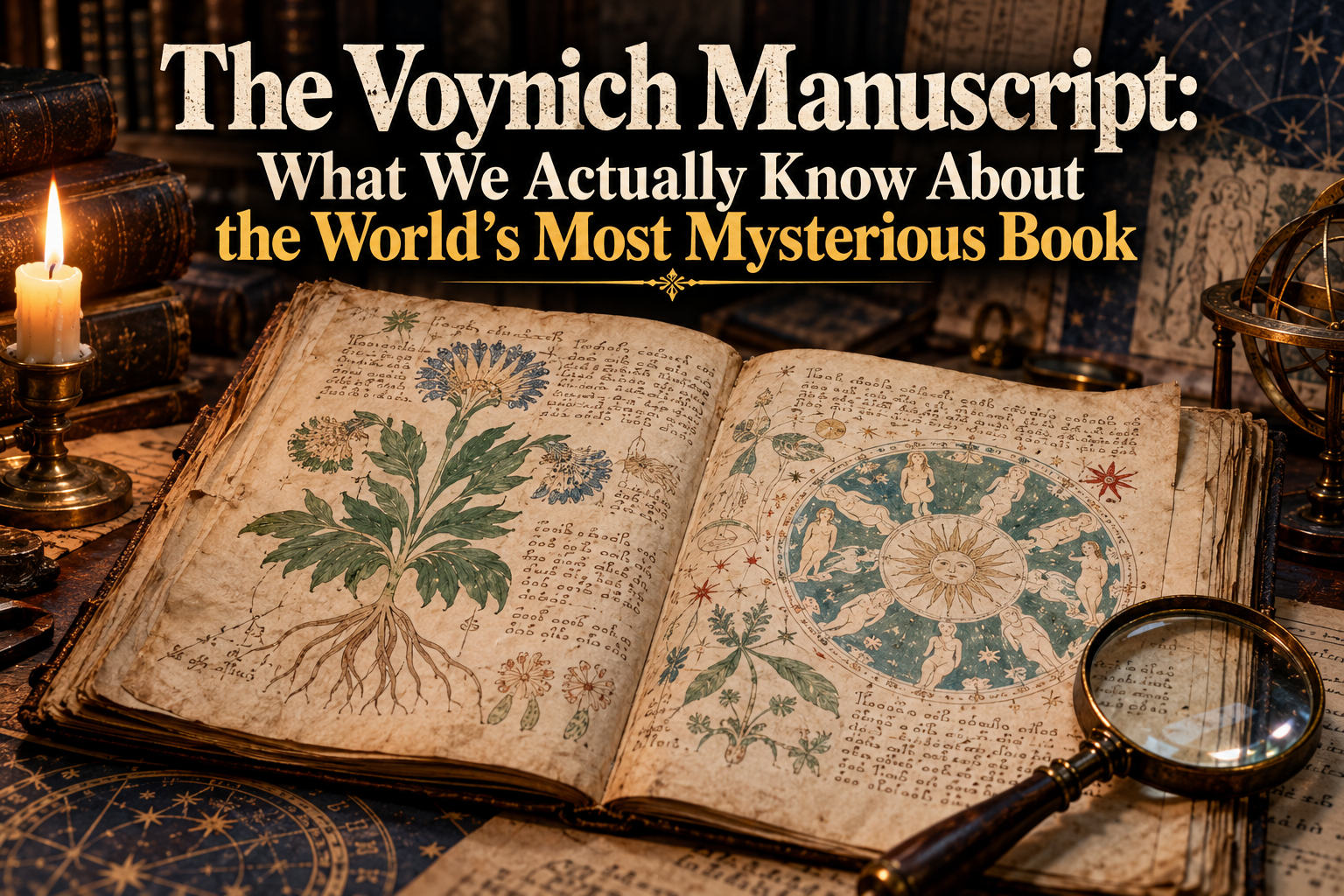
Somewhere in Central Europe, around the 1420s, someone sat down with a stack of freshly prepared calfskin and began filling it with a script no one has been able to read since. The writing flows confidently, without hesitation or crossed-out mistakes, as if the scribe knew exactly what each word meant. Around it bloom plants that don’t quite match any known species, star charts ringed by zodiac signs, and pages of small nude women bathing in pools connected by strange tubes.
Six centuries later, that book sits in a climate-controlled vault at Yale University under the catalog number MS 408. Emperors, Jesuit scholars, and the codebreakers who cracked Japanese military ciphers in World War II have all tried to read it. Every one of them failed. This is the Voynich manuscript, and the most honest thing anyone can say about it is also the most remarkable: after more than a hundred years of modern study, we still don’t know what it says, who wrote it, or even whether it says anything at all.
Here is what is actually documented, what has been claimed, and why every “breakthrough” you’ve seen in the headlines has so far come up short.
What Is the Voynich Manuscript?
The Voynich manuscript is an illustrated handwritten book, or codex, written in an unknown script and an unidentified language or code. It is held by Yale’s Beinecke Rare Book and Manuscript Library as Beinecke MS 408 and is named after Wilfrid Voynich, the Polish-born antiquarian bookseller who bought it in 1912.
The basics are well established:
- Size: a small book, about 23.5 × 16.2 cm (roughly 9.3 × 6.4 inches).
- Length: around 240 surviving pages, gathered into 18 quires (bundles of folded sheets). Gaps in the page numbering show that at least 14 leaves, or 28 pages, are missing.
- Material: vellum made from calfskin.
- Text: roughly 38,000 “words” made up of more than 170,000 individual characters, written in a script of about two dozen recurring glyphs.
- Foldouts: several large pages fold out to several times the size of a normal page, including one enormous sheet with nine linked circular “rosettes.”
When Was It Made? The Science of the Parchment
For most of the 20th century, people argued about the book’s age. Some believed it was the work of the 13th-century English friar Roger Bacon; others thought it might be a 16th- or even 20th-century forgery.
Science narrowed that range dramatically in 2009. A team at the University of Arizona, led by physicist Greg Hodgins, radiocarbon-dated small samples from four separate leaves. The results placed the creation of the parchment between 1404 and 1438, with 95 percent probability. Chemical analysis of the inks and paints found materials consistent with the period, and imaging found no evidence that older writing had been scraped away and overwritten.
There is one important caveat: radiocarbon dating tells us when the animal died, not when the ink went on. In theory, a later forger could have used old blank vellum. In practice, most specialists consider that unlikely, because finding a large stack of matching, unused 15th-century parchment would have been extremely difficult, and the handwriting and page construction fit the early 15th century well. The working consensus is that the book was written in the first half of the 1400s, most likely somewhere in Central Europe.
That single test killed two popular theories at once. It ruled out Roger Bacon, who died around 1292, and it badly damaged the idea that Wilfrid Voynich forged the book himself.
What’s Inside: The Six Sections
Because nobody can read the text, the sections are named after what the pictures appear to show. The Beinecke Library divides the book into six parts:
- Herbal. The longest section. Each page shows a single plant, usually with roots, leaves, and flowers, surrounded by text. A few resemble real plants; most cannot be confidently identified, and some look like hybrids of several species.
- Astronomical and astrological. Circular diagrams with suns, moons, stars, and what appear to be zodiac symbols, including a fish for Pisces and a bull for Taurus. Some of the month names on these pages are written in an ordinary Latin-alphabet script, likely added by a later hand.
- “Balneological” or biological. The strangest pages. Small nude women stand or recline in pools of blue or green liquid, linked by pipes and tubes that some readers see as plumbing and others as organs of the human body.
- Cosmological. More circular diagrams, including the huge foldout of nine interconnected rosettes, with what look like castles, roads, and walled enclosures.
- Pharmaceutical. Drawings of plant parts, especially roots and leaves, set beside containers that resemble the apothecary jars of the period.
- Recipes. About two dozen pages of continuous text, with no illustrations, divided into short paragraphs that each begin with a small star in the margin.
The overall shape resembles a familiar medieval genre: a manual of natural knowledge, medicine, astrology, and bathing cures. That’s part of what makes the book so frustrating. It looks like something a 15th-century physician might own, yet nothing in it can be read.
The Chain of Owners: From an Emperor to Yale
The book’s documented history begins in the 1600s, more than a century after it was made, and almost everything we know comes from a letter that is still kept with it.
- Emperor Rudolf II (ruled 1576–1612). In a letter dated 1665, the Prague physician Johannes Marcus Marci wrote that the manuscript had once been bought by Holy Roman Emperor Rudolf II, an avid collector of the rare and the occult, for 600 gold ducats, a very large sum. Marci also passed on the rumor that the author was Roger Bacon. Yale’s own description treats the Rudolf purchase as the first likely ownership and the Bacon attribution as speculation.
- Jacobus Hořčický de Tepenec (c. 1575–1622). Rudolf’s court pharmacist and chemist. A faded signature on the first page, now visible only under ultraviolet light, reads “Jacobj à Tepenecz.” Researchers have noted that it doesn’t perfectly match other known examples of his signature, so even this clue carries a question mark.
- Georg Baresch. A Prague alchemist who owned the book by 1637 and wrote to the famous Jesuit polymath Athanasius Kircher in Rome, asking for help reading it. Kircher, who claimed to have decoded Egyptian hieroglyphs, apparently showed little interest.
- Johannes Marcus Marci. Inherited the book from Baresch and sent it to Kircher with his own letter. That letter is still tucked inside the manuscript today.
- The Jesuits. The book vanished into Jesuit collections for about 250 years.
- Wilfrid Voynich (1912). Voynich bought it from a Jesuit collection at the Villa Mondragone near Frascati, outside Rome. He spent the rest of his life trying to have it deciphered and promoting the Roger Bacon theory.
- After Voynich. His widow, Ethel Lilian Voynich, best known as the author of the novel The Gadfly, left it to her friend Anne Nill. In 1961, Nill sold it to New York rare book dealer Hans P. Kraus, who failed to find a buyer at his asking price. In 1969, Kraus donated it to Yale, where it has been ever since.
What we do not have is any record of the book’s first two centuries. Who commissioned it, where, and why remain completely unknown.
Why Is the Voynich Script So Hard to Crack?
Researchers call the writing “Voynichese.” It is not gibberish in the obvious sense. It behaves, in many ways, like real language:
- Word frequencies follow Zipf’s law, the pattern found in natural languages where the most common word appears about twice as often as the second most common, three times as often as the third, and so on.
- Words have structure. Certain characters appear only at the beginning of words, others only at the end, just as in real writing systems.
- There are two “dialects.” In the 1970s, the American cryptologist Prescott Currier showed that the text falls into two statistically distinct varieties, now called Voynich A and Voynich B, with different vocabulary and spelling habits. In 2020, medieval manuscript expert Lisa Fagin Davis used digital paleography to argue that the book was written by five different scribes, and their hands line up with the A/B split.
- Words cluster by topic. A 2013 study in PLOS ONE by physicists Marcelo Montemurro and Damián Zanette found that certain words concentrate in specific sections, the way topic-related vocabulary does in meaningful texts.
But other features are deeply strange. The text is far more repetitive and predictable than any known language. The same word often appears two or three times in a row. Very short words dominate, and there are almost no one- or two-letter words of the kind that fill European languages. In a 2021 review in the Annual Review of Linguistics, linguists Claire Bowern and Luke Lindemann concluded that the character-level patterns are unusually predictable compared with natural languages, which is one reason a simple substitution of one letter for another cannot explain it.
That combination is the core of the mystery: too structured to be random scribbling, too odd to be any known language written plainly.
The Major Theories, and Where Each One Stands
1. It’s a cipher
The oldest and still very much alive idea is that Voynichese hides a known language, probably Latin or an early Italian or German dialect, behind a code.
The most important recent work here came in late 2025, when science journalist and independent researcher Michael Greshko published a paper in the cryptography journal Cryptologia describing what he calls the Naibbe cipher. It is a “verbose” homophonic substitution system, meaning each plaintext letter can be replaced by several different strings of Voynich-like characters, chosen with the help of ordinary playing cards, including the 78-card tarot deck that existed in early 15th-century Italy. Greshko showed that Latin and Italian text run through this system comes out looking statistically much like Voynichese, using only tools available at the time.
What the study does not do is decode a single line of the manuscript. Greshko presents it as proof that a cipher explanation remains viable, not as the actual key, and he notes it doesn’t fully reproduce the properties of Voynich B. Earlier, the codebreaker John Tiltman, asked by William Friedman to study the book in 1950, also concluded it was some kind of cumbersome mixed substitution system.
Status: plausible, actively researched, unproven.
2. It’s a natural language in an invented script
Under this view, there’s no code at all: someone simply wrote a real language, perhaps one rarely written down, in a newly invented alphabet. Candidates have ranged from Hebrew and Turkic languages to Nahuatl and Manchu.
The best-known attempt was by Stephen Bax, a linguistics professor in the UK, who in 2014 proposed provisional readings for about 14 characters and 10 words, mostly plant and star names such as “Taurus” next to the Pleiades. Bax was careful to call it a partial, tentative step, and he died in 2017 without completing a translation. His identifications were not accepted by most specialists.
In 2016, computing scientists Greg Kondrak and Bradley Hauer at the University of Alberta used a statistical algorithm and concluded that the text was most likely Hebrew with letters rearranged into alphagrams. The idea made headlines again in 2018, but Hebrew scholars who looked at the proposed readings found them unconvincing.
Status: possible in principle, but no proposed language has produced a readable translation.
3. It’s an invented language
William Friedman, America’s most famous codebreaker, led study groups on the manuscript from the 1940s onward. He eventually came to believe it was written in an early artificial or “philosophical” language, an a priori system in which words are built from meaningful parts. The repetitive, highly structured word forms fit this idea reasonably well. The problem is timing: such constructed languages are associated with the 17th century, and the parchment is roughly 200 years older.
Status: an elegant idea with an awkward historical gap.
4. It’s a hoax or meaningless text
In 2004, Gordon Rugg, a computer scientist at Keele University, showed in Scientific American that a table of syllables combined with a card-and-grid tool called a Cardan grille could generate text with many Voynich-like properties. He suggested a single person could produce a comparable book in a few hundred hours. Researchers Torsten Timm and Andreas Schinner later proposed a “self-citation” method, in which the scribe produces new words by copying and slightly altering nearby ones.
Critics counter that Cardan grilles were described about a century after the parchment dates, that no historical evidence shows them used this way, and that the topic-based clustering of words is hard to explain with a random generator. Supporters reply that a deliberately meaningless book could still be a valuable fake: something to sell to a wealthy collector like Rudolf II.
Status: taken seriously by some researchers; contested by many.
5. It’s a medical book about women’s health and sex
In 2024, historians Keagan Brewer and Michelle Lewis published a paper in Social History of Medicine arguing that parts of the manuscript, especially the bathing women and the giant rosette foldout, reflect late-medieval ideas about sex, conception, and gynecology. They point to the Bavarian physician Johannes Hartlieb (c. 1410–1468), who recommended writing sensitive medical recipes related to contraception and pregnancy in cipher. Their argument rests on comparisons with period medical texts, not on decoded words, and they acknowledge that much remains unexplained. Earlier, a 2017 claim by researcher Nicholas Gibbs that the book was an abbreviated Latin women’s health manual was quickly rejected by experts, including Davis, who said his decipherment didn’t produce Latin that makes sense.
Status: an interesting interpretation of the pictures, not a reading of the text.
The “Solutions” That Didn’t Hold Up
Few manuscripts have been “decoded” more often. A short list of famous claims that collapsed under scrutiny:
- William Newbold (1921): A University of Pennsylvania professor claimed tiny shorthand marks hidden inside each letter proved Roger Bacon had invented the microscope. Medievalist John Manly showed in 1931 that the “marks” were just cracks in drying ink.
- Nicholas Gibbs (2017): abbreviated Latin medical text. Rejected by specialists within days.
- Gerard Cheshire (2019): A University of Bristol researcher published a peer-reviewed paper claiming the book was written in “proto-Romance.” After strong criticism from linguists and medievalists, the university withdrew its press release.
The pattern repeats so often that Lisa Fagin Davis, who handled Voynich inquiries while at Yale and now leads the Medieval Academy of America, has become a kind of informal referee. A real solution, she and others argue, must produce coherent, grammatical text across many pages, using one consistent method, not a handful of cherry-picked words.
What the Newest Research Shows
Two recent developments point to where the field is heading.
First, in September 2024, Davis published multispectral images of ten pages, captured at Yale about a decade earlier. On the very first page, faded under ultraviolet light, sit three columns of letters: a Roman alphabet, a row of Voynich characters, and a second, shifted Roman alphabet. Davis believes Johannes Marcus Marci added them, which would make it one of the earliest documented attempts to crack the code. It’s a small, haunting detail: someone in the 1660s was trying exactly what we’re still trying today.
Second, the subject is now drawing formal academic attention. The University of Malta has scheduled an online, multidisciplinary Voynich conference for December 9, 2026. Combined with computational studies like Greshko’s, that suggests the next breakthrough, if one comes, is more likely to emerge from statistics, imaging, and manuscript history than from a lone genius announcing a translation.
What Remains Unknown
After all this work, the honest list of open questions is long:
- Who wrote it, and who paid for it?
- What language, if any, lies underneath the script?
- Is it a cipher, a constructed language, a hoax, or something we haven’t thought of?
- What do the plants, rosettes, and bathing scenes actually represent?
- Where was the book between the 1430s and the early 1600s?
What we can say with confidence is narrower but solid: the book is genuine 15th-century work, not a modern forgery; it was written by several scribes with practiced hands; and its text has real, measurable structure. Every mystery has a deeper story, and the Voynich manuscript is proof that some stories can hide in plain sight for six hundred years. The entire book is freely available online through Yale’s digital collections, which means the next serious attempt could come from anyone willing to look closely.
Frequently Asked Questions
Has the Voynich manuscript ever been decoded? No. Many people have announced solutions, but none has been accepted by specialists, because none produces coherent, consistent text across the whole book.
How old is the Voynich manuscript? Radiocarbon tests carried out in 2009 date its parchment to between 1404 and 1438. Most experts believe the text and pictures were added soon after the parchment was made.
Where is the Voynich manuscript kept today? At the Beinecke Rare Book and Manuscript Library at Yale University in New Haven, Connecticut, as Beinecke MS 408. High-resolution scans of every page are free to view online.
Who wrote the Voynich manuscript? Nobody knows. Roger Bacon was ruled out by the radiocarbon dating. Handwriting analysis by Lisa Fagin Davis suggests five different scribes worked on it.
Could the Voynich manuscript be a hoax? It’s possible. Some researchers have shown that meaningless Voynich-like text can be generated with simple period techniques. Others argue that the way vocabulary clusters by topic points to real content. There is no consensus.
Why is it called the Voynich manuscript? It’s named after Wilfrid Voynich, the rare book dealer who bought it in 1912 and introduced it to the modern world.
Sources
- Michael A. Greshko, “The Naibbe cipher: a substitution cipher that encrypts Latin and Italian as Voynich Manuscript-like ciphertext,” Cryptologia (published online November 26, 2025)
- Keagan Brewer and Michelle L. Lewis, “The Voynich Manuscript, Dr Johannes Hartlieb and the Encipherment of Women’s Secrets,” Social History of Medicine 37, no. 3 (2024): 559–582
- Voynich Manuscript — Beinecke Rare Book & Manuscript Library, Yale University
- Voynich manuscript — Britannica
- Radiocarbon dating of the Voynich MS — voynich.nu (René Zandbergen)
- Mysterious Voynich Manuscript Dates Back to the 15th Century — Medievalists.net
- Eamon Duffy, “The Voynich Manuscript: Secret Knowledge or Hoax?” — The New York Review of Books
- Historically Plausible Cipher Recreates Statistical Signature of Voynich Manuscript — Sci.News
- Hidden Secrets of the Voynich Manuscript Revealed Through Cutting-Edge Scans — Medievalists.net
- For 600 Years the Voynich Manuscript Has Remained a Mystery. Now We Think It’s Partly About Sex — The Conversation
- Montemurro & Zanette, “Keywords and Co-Occurrence Patterns in the Voynich Manuscript” — PLOS ONE (via PMC)
- The Strange Quest to Crack the Voynich Code — Undark
- Lisa Fagin Davis — Wikipedia
- Gordon Rugg — Wikipedia
- Voynich manuscript — Wikipedia
- Voynich Conference 2026 — University of Malta
