

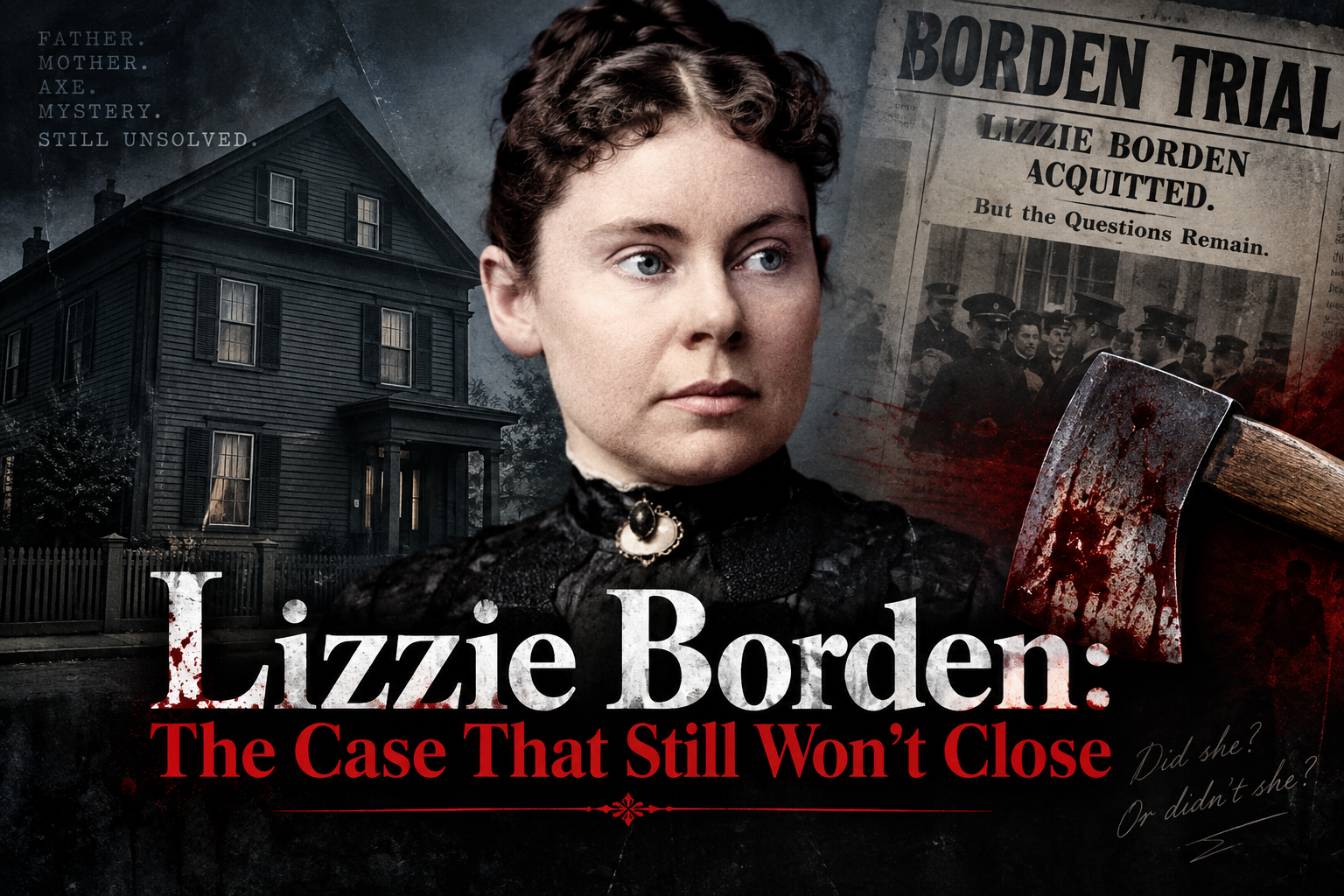
On the morning of August 4, 1892, someone walked into the Borden house on Second Street in Fall River, Massachusetts, and killed Andrew Borden and his wife Abby with a hatchet, roughly ninety minutes apart, without anyone hearing a scream, a struggle, or a door. The only other person confirmed to be in the house at the time was Andrew’s 32-year-old daughter, Lizzie. Ten months later, a jury took less than an hour and a half to acquit her.
That verdict never actually settled anything, which is exactly why the case has never let go of the public imagination. On September 17, 2026, Netflix releases Monster: The Lizzie Borden Story, with Ella Beatty in the title role, and the case is about to be relitigated in living rooms all over again. It’s a useful excuse to go back to what is actually documented, as opposed to what more than a century of nursery rhymes, films, and dinner-table folklore has added to it, and to ask the question that has never had a satisfying answer: if Lizzie Borden didn’t do it, who did? And if she did, how did she walk free?
A Wealthy Family Living Like It Wasn’t
Fall River in 1892 was a cotton-mill town of about 75,000 people, sharply divided between old-money families on “the Hill” and the largely Irish immigrant workers who ran the mills. Andrew Jackson Borden belonged, by wealth, on the Hill. He was president of the Union Savings Bank and sat on the boards of half a dozen companies, worth an estimated quarter of a million dollars — a genuine fortune in 1892. He chose to live on Second Street, in a plain house without indoor plumbing on the upper floor, among more modest neighbors. Andrew had started as an undertaker and never lost the habits of a man who’d built his money one hard bargain at a time. He was not, by any account, a well-liked man.
He had two surviving daughters from his first marriage: Emma, 41 at the time of the murders, and Lizzie, 32. Their mother had died when Lizzie was two, and Andrew remarried a widow named Abby Durfee Gray three years later. Neither daughter ever fully accepted her. Lizzie in particular referred to Abby as “Mrs. Borden,” not “Mother,” and told a family dressmaker years earlier that her stepmother was “a mean good-for-nothing.” The household was not violent or openly hostile, by every account, including that of the family’s live-in maid, Bridget Sullivan — but it was cold. The daughters kept largely to their own rooms and didn’t always eat with their parents. Doors, inside and out, were kept locked as a matter of routine, even between rooms on the same floor.
That locked, oddly compartmentalized house matters enormously to the case, because the layout is what turns the murders from an ordinary crime into a locked-room puzzle. The property line ran along a busy public street. The only two entrances were routinely bolted from the inside. Upstairs, Lizzie’s room connected to a guest room and to her parents’ bedroom, but the connecting doors were kept locked and blocked with furniture — the only way in or out of the elder Bordens’ room was down a back staircase from the kitchen. Whoever killed Andrew and Abby Borden either knew that house intimately, or was extraordinarily lucky.
The Morning of August 4
The day before the murders was strange in ways nobody noticed until afterward. Lizzie’s uncle, John Morse, arrived for a brief, unannounced visit. Abby Borden went to see the family doctor, convinced she’d been poisoned; he dismissed it as spoiled food in the summer heat. That evening, Lizzie paid an unusual visit to her friend Alice Russell and, unprompted, talked for two hours about a vague, building dread: that her father had enemies, that the barn had been broken into, that she was afraid “somebody will do something.” She never explained who, or what.
On the morning of the 4th, the house emptied out in stages. Morse left around 8:45 a.m. Andrew Borden left for his morning rounds downtown at about 9:15. That put only two people inside the house for the next hour and a half: Lizzie, and her stepmother Abby, who went upstairs around 9:30 to change the pillowcases in the guest room. Bridget Sullivan, the maid, was outside the whole time, washing windows in full view of the street.
Somewhere in that window, Abby was struck from the front while standing in the guest room, then struck roughly 18 more times with a hatchet after she had already fallen. She never called out. Andrew returned home around 10:45 and struggled to get in — the door was triple-locked. Bridget let him in; Lizzie, by her own account and Bridget’s, was on the landing at the top of the stairs, within about twenty feet of Abby’s body, laughing. She told her father that Abby had gone out on a sick call. Andrew lay down on the sitting-room sofa. Bridget went up to her attic room to rest.
At around 11:10, Lizzie called Bridget down. “Come down quick, father’s dead. Somebody came in and killed him.” Andrew had been struck about ten or eleven times in the face and skull as he lay on the couch, apparently asleep, his injuries so severe that a doctor on the scene said they made him unrecognizable. He had been killed within the previous twenty minutes. Nobody, on a house-lined public street in the middle of a summer morning, had seen anyone enter or leave.
What Lizzie Said, and Kept Changing
Five days after the murders, Lizzie was questioned for three days at a coroner’s inquest by District Attorney Hosea Knowlton. That testimony was later ruled inadmissible at her actual trial — the jury never heard it — but the transcript survives, and it’s the closest thing the case has to a cross-examination of Lizzie herself, since she never testified at trial.
It does not hold together. Asked where she was when her father was killed, she told Bridget and a neighbor, Adelaide Churchill, that she’d been in the barn looking for a piece of iron. At the inquest, days later, she said she’d been in the kitchen, then corrected herself to the stairs, then corrected herself again to the kitchen. Bridget’s own account placed her upstairs, near the guest room, laughing, at the exact moment her father was let into the house — which put her within feet of her stepmother’s body an hour before anyone claimed to “discover” it.
Then there’s the sick note. Lizzie told Bridget, and later her father, that Abby had left the house after receiving a note that a friend was ill. No such note was ever found. No friend came forward. No messenger was identified, despite public appeals. And Lizzie’s own account of it kept shifting: whether she’d seen Abby leave, whether she’d heard her come back, whether she suspected her stepmother might have been the person murdered too. Under questioning she said, unprompted, that she thought she’d heard Abby come back in — a striking thing to volunteer if she genuinely believed Abby was safely out running errands while her father lay dying downstairs.
The day before the murders, according to three employees of a nearby pharmacy, a woman they identified as Lizzie had tried to buy ten cents’ worth of prussic acid, a fast-acting poison, and been refused. The trial judge excluded that evidence entirely, on the reasoning that a case about a hatchet had no need of testimony about poison — a ruling that later legal commentators, including retired London judge Ronald Bartle, have called nearly indefensible on ordinary rules of evidence.
The Trial: A Missing Weapon, a Burned Dress, and No Blood
Lizzie was indicted and tried before the Massachusetts Superior Court starting June 5, 1893, prosecuted by Hosea Knowlton and William Moody and defended by former Massachusetts governor George Robinson. Three things dominated the case, and all three ultimately worked in Lizzie’s favor.
The weapon. Police found a hatchet head in the cellar, its handle recently snapped off, dusted with fine ash as if someone had tried to disguise a fresh break. Its blade was the right size to match the wounds. But the prosecution’s own chemist, Harvard’s Professor Edward Wood, tested it and found no trace of blood — and admitted under cross-examination that a hatchet could theoretically be washed clean enough to defeat 1892-era testing, which cut both ways. No axe covered in blood was ever found on Lizzie, in the yard, or anywhere between the house and any point she could have reached. William Moody opened the case by telling the jury the Commonwealth could only say the hatchet “may have been” the weapon — hardly a ringing start.
The blood. This was the defense’s strongest card. Multiple credible witnesses, including neighbor Adelaide Churchill and Lizzie’s friend Alice Russell, examined her within minutes of the murders being discovered and swore under oath that there was no blood on her clothes, hands, face, or hair — despite medical experts agreeing that whoever swung the hatchet at Abby, standing over her and delivering blow after blow, would almost certainly have been spattered. One doctor found a single pinhead-sized blood spot on a petticoat, which he couldn’t rule out as menstrual blood. DNA testing didn’t exist; this question was never actually resolved.
The dress. Three days after the murders, with police openly watching the house, Lizzie burned a blue cotton dress in the kitchen stove, telling her sister Emma it was “covered with paint” and useless. Alice Russell, who witnessed it, later testified she thought it looked like the same dress Lizzie had worn the morning of the murders — a claim two other witnesses, including Mrs. Churchill, backed when they said the dress Lizzie later handed over to police didn’t match what she’d actually been wearing that day. The defense’s version was that this was an entirely different, older dress and that the burning was innocent, if catastrophically timed.
On June 20, 1893, after a trial covering thirteen days, the jury took roughly ninety minutes to return a verdict of not guilty. Contemporary accounts suggest most of them had decided within minutes and simply waited long enough not to look hasty. Knowlton, the lead prosecutor, is on record telling colleagues before the trial that he personally wanted no part of it and didn’t expect a conviction — an odd admission from the man tasked with securing one.
If Not Lizzie, Who?
The defense’s official theory was an unknown intruder. It runs into a wall of practical problems that later writers, including British judge Ronald Bartle in Lizzie Borden and the Massachusetts Axe Murders (2017), have laid out in detail: the doors were kept locked as a matter of household routine; the killer would have needed to know the house’s layout well enough to find a hatchet in the cellar, corner Abby upstairs, then wait roughly ninety minutes, undetected, before killing Andrew downstairs; and he or she would then have had to walk out onto a busy residential street in broad daylight, covered in blood, without a single person noticing. Nobody was ever seen approaching or leaving the house. No weapon, no bloody clothing, and no physical trace of an outsider were ever recovered.
Three named people other than Lizzie have been floated as suspects over the decades, and each has a fairly short rebuttal. Bridget Sullivan, the maid, was outside washing windows in view of the street when Abby was killed and resting in her attic room, reachable only by a back staircase, when Andrew was killed; she had no known motive and gave consistent, credible testimony that neither helped nor hurt Lizzie’s case. John Morse, Lizzie’s uncle, had left the house before 9 a.m. and was accounted for by multiple witnesses during the entire window of the murders. Emma Borden, Lizzie’s older sister, was documented to be fifteen miles away staying with friends and had been for two weeks.
A more elaborate theory surfaced in 1991, when author Arnold Brown proposed that Andrew Borden had a secret illegitimate son, William, who committed the murders out of resentment over his exclusion from the family fortune. Brown built the theory around family rumors and a Learning Channel documentary later dramatized it — but Brown himself acknowledged he had no direct evidence connecting any such man to the crime scene, and Borden researchers have generally treated it as speculative fan-fiction dressed up as history rather than a serious alternative.
Which leaves the same two possibilities that confronted the original jury: an intruder nobody saw, who somehow knew the house and had almost supernatural luck, or the one adult present in the building for both killings, with an established dislike of the victim, a documented string of shifting and uncorroborated statements, and a burned dress three days later.
Free, Rich, and Alone
Acquittal didn’t buy Lizzie a normal life. She and Emma inherited their father’s fortune and used it to buy Maplecroft, a fourteen-room house on the Hill — the address she’d effectively been shut out of her whole childhood. She started going by “Lizbeth A. Borden.” It didn’t help. Fall River never let the case go: children reportedly threw stones at the house, former friends and fellow churchgoers cut her off, and local newspapers kept up a steady drumbeat of coverage that stopped just short of accusing her outright. A shoplifting accusation in Rhode Island in 1897 gave the gossip fresh fuel.
Even her relationship with Emma, her staunchest defender during the trial, didn’t survive it. Around 1904, Lizzie struck up a close, much-gossiped-about friendship with stage actress Nance O’Neil, hosting lavish parties for her at Maplecroft. Emma moved out in 1905 and the sisters remained estranged for the rest of their lives, living apart for more than two decades without reconciling. Asked once why she’d left, Emma would only say she had to “refuse to talk about” whatever happened on French Street.
Lizzie died in Fall River on June 1, 1927, at 66, from pneumonia that set in after gallbladder surgery. That same day, in New Hampshire, 76-year-old Emma suffered a fall and broke her hip; she died nine days later of kidney disease. Neither sister ever spoke publicly about what happened on August 4, 1892, again.
Why the Case Never Closes
The children’s skipping rhyme that made Lizzie Borden a household name gets the basic facts wrong on purpose: “Lizzie Borden took an axe / and gave her mother forty whacks.” She was never convicted of anything, Abby was her stepmother, the weapon was almost certainly a hatchet, and the actual wound counts were roughly 18 or 19 blows for Abby and 10 or 11 for Andrew — gruesome enough without doubling it into folklore. That’s the durable shape of the whole case: a legend that hardened faster than the facts could keep up, built on a trial that answered a narrow legal question (guilty beyond a reasonable doubt, or not) rather than the one everyone actually wanted answered.
The house at 92 Second Street still stands and now operates as a museum and bed-and-breakfast, where guests can spend the night in the room where Andrew Borden was killed. The case has generated dozens of books, several stage productions, an opera, a ballet, and multiple film and TV adaptations, most recently Netflix’s Monster: The Lizzie Borden Story, premiering September 17, 2026, the fourth installment in Ryan Murphy’s Monster anthology after seasons on Jeffrey Dahmer, the Menendez brothers, and Ed Gein. In 2012, a previously unknown cache of defense attorney Andrew Jennings’s private trial journals surfaced and was eventually published in 2021 — a reminder that, more than 130 years on, the case is still capable of producing new primary material, even if none of it has settled the central question.
What’s actually left, stripped of the rhyme and the reenactments, is a genuinely unresolved evidentiary puzzle: a household with means, motive, and opportunity concentrated almost entirely on one person, a prosecution that badly fumbled its strongest pieces of evidence, and a defendant whose class, gender, and reputation may have done more to acquit her than anything argued in court. Whether that adds up to innocence or to one of the best-executed escapes in American criminal history is still, genuinely, an open question — which is precisely why, 134 years later, people are still buying tickets to find out.
Frequently Asked Questions
Was Lizzie Borden ever convicted or sent to prison? No. A jury acquitted her on June 20, 1893, after roughly 90 minutes of deliberation. No one else was ever charged with the murders, and the case remains officially unsolved.
How many times were Andrew and Abby Borden actually struck? Medical testimony put it at about 10 to 11 blows to Andrew’s head and face, and roughly 18 to 19 to Abby’s — not the “forty whacks” of the nursery rhyme, which was never meant as a factual count.
What was the murder weapon? Almost certainly a hatchet, based on wound size and shape. A handleless hatchet head was found in the Borden cellar with a freshly broken handle and ash residue, but the prosecution’s own chemist found no blood on it, and it was never definitively confirmed as the weapon.
Why was there no blood on Lizzie’s clothes? That was never fully explained. Multiple witnesses swore under oath there was no blood on her clothing, hands, or hair minutes after the bodies were found, despite medical experts agreeing the killer would likely have been spattered. It remains one of the strongest arguments for her innocence — or for how effectively she cleaned up in the roughly 20 minutes before Andrew’s body was found.
Do modern historians think Lizzie did it? There’s no consensus, but most Borden researchers consider her the most plausible suspect by a wide margin, given that she was the only person confirmed to be alone in the house with each victim, her shifting accounts, and the burned dress. No credible alternative suspect or intruder theory has ever produced supporting physical evidence.
Is the Borden house still standing? Yes. The house at 92 Second Street in Fall River, Massachusetts, is preserved as a museum and now operates as a bed-and-breakfast, where overnight guests can book the room in which Andrew Borden was killed.
Sources
- Ronald Bartle, Lizzie Borden and the Massachusetts Axe Murders (Waterside Press, 2017) — trial transcript excerpts, inquest testimony, and legal analysis
- Lizzie Borden: Murder Trial, Acquittal, and Life Afterward — Biography.com
- What Happened to Lizzie Borden After Her Murder Trial? — Biography.com
- Lizzie Borden — Britannica
- Was Lizzie Borden Guilty? — Britannica
- How Did Lizzie Borden Die? — Britannica
- How Lizzie Borden Got Away With Murder — Smithsonian Magazine
- 9 Things You May Not Know About Lizzie Borden — History.com
- Arnold Brown’s Theory on the Borden Case — Mondo Lizzie Borden
- Monster: The Lizzie Borden Story — Wikipedia
